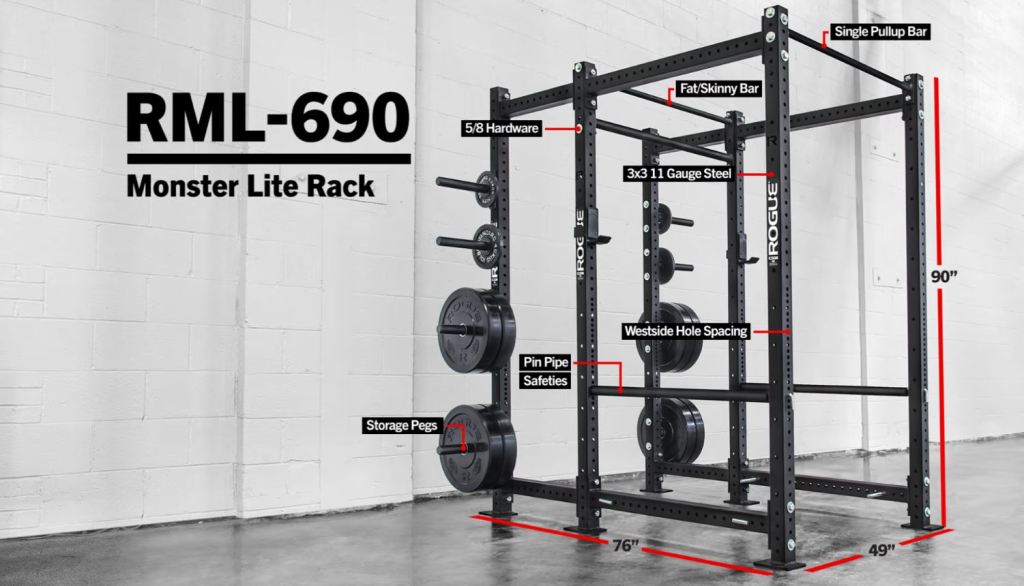
Having a proper power rack is essential for anyone who is serious about weight training. They can be combined with attachments like cable pulleys and pullup bars to offer you a bunch of different ways to train. More importantly, however, they offer you protection by acting like a spotter when you’re doing lifts like squats and bench press.
I have used my fair share of power racks and because of both the cost and the importance of choosing the right rack for myself, I took my time when deciding on which rack I would buy. Two years later, I could not be happier with my decision.
The main reasons why I chose this rack in particular are the size and strength of it and the fact that Rogue doesn’t require you to bolt it to the ground.
As someone with some experience squatting and bench pressing, I knew that I would need a solid rack. I have had a few close calls with cheaper racks almost tipping over when I re-rack the bar, so I wanted to make sure that I wouldn’t have to worry about that, especially as both myself and my clients start using heavier weight. It’s not too big of a deal if you re-rack 135 a bit too hard, but as I have come close to learning the hard way, when you’re amped up and slam back a 400-500 bar, having the wrong rack means that the EMTs are going to need a spatula to get you off the ground.
Almost all of Rogue’s power racks say in the details that they must be bolted to the floor, which wasn’t something that I was thrilled about doing. I did a bunch of research into different ways getting around this, like building a platform underneath it to bolt to, but this approach got mixed reviews. However, in one of the forums I read, someone mentioned that you don’t need to bolt down the RML-690 rack because it has six legs instead of four, and weighs in at 530 lbs, making it far more stable than its lighter, four-legged competitors. A quick check of the Rogue website confirmed that this is indeed the case.
Two other things that I really appreciate about this rack are that I can store my plates on the back side of the rack (as seen in the picture), which gives me more space to maneuver than in a four-legged rack. I also find myself using all three pullup bars fairly often because I have a cable pulley that hooks to one of the bars and often have group workouts that involve pullups.
The setup for this rack wasn’t too difficult, but it took a few sets of hands, especially for the last few steps (combining the pair of three-legged halves of the rack). The box of nuts, washers, and bolts for this rack was roughly 40 lbs, so if you use a wrench for this, it will take you a while. I highly recommend using an impact gun. Once assembled, the rack sat perfectly flat, and with the exception of a few chips in the paint from shipping (which I mentioned to Rogue and they refunded the shipping costs), the paint and the rest of the rack have held up immaculately.
If you are comfortable bolting down your power rack, there are cheaper racks that will still get the job done. At $1,775, this is one of the more expensive racks out there. However, if you, your landlord, parents, or significant other aren’t too keen on having to bolt a rack into concrete, I highly recommend the Rogue RML-690 Power Rack.
 Seaotter Fitness