So the market moves in cycles. How do I know when I should start buying?
There are common methods that are used for this:
A) Buying the Dip: When your chosen investment falls by a certain amount (aka the price dips), you start buying. People often choose different criteria for what they consider “the dip,” such as the price falling 5%, 10%, or 20%.
or
B) You can invest your money a little bit at a time at a set interval so that you’re buying at a bunch of different prices. This allows you to take advantage of lower stock prices when they do arrive without having to worry that you’re waiting for a price dip that never comes.
So which method tends to perform better?
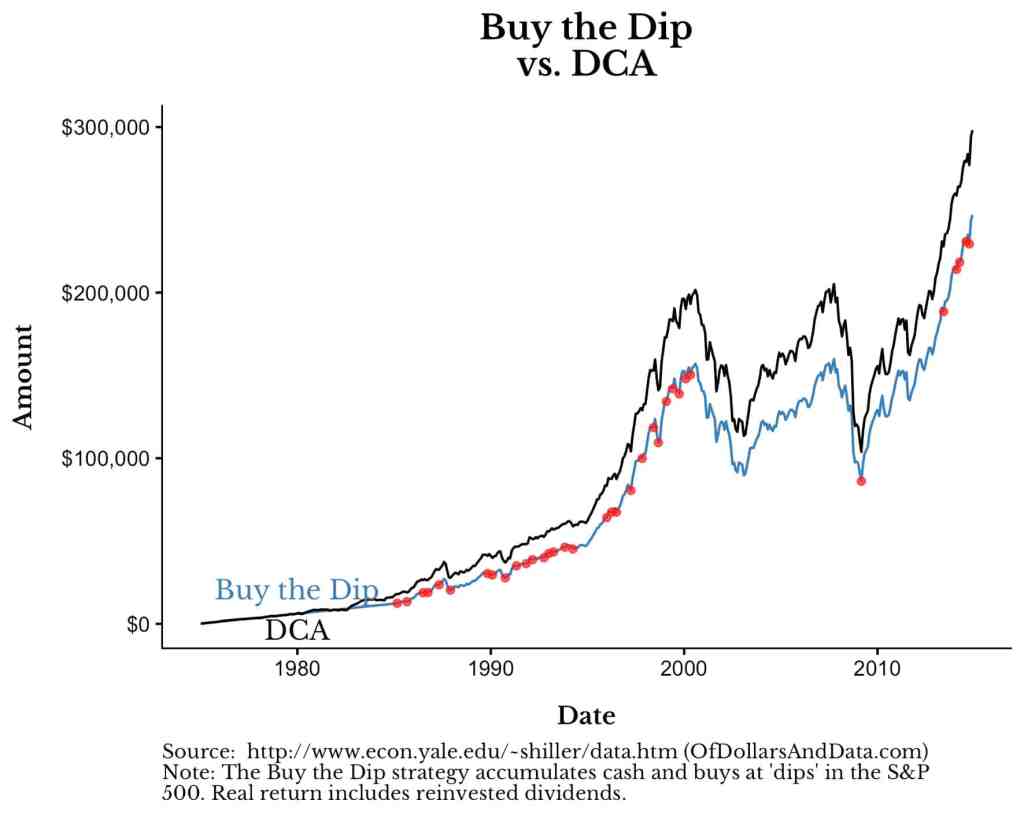
As you can see from the chart, dollar cost averaging tends to perform better over the long run. One of the big reasons for this is that if you’re buying the dip, you might have to wait a while to invest your money, and things can move a lot higher in the meantime. If you are waiting for the your chosen investment to fall 10% and over the course of a few years, it goes from $100 to $200 to $180, your purchase price is $180 (10% lower from $200). If you buy a little bit every time you get your paycheck, you are getting some for $100, some for $103, some for $107, etc. and you tend to get a much lower overall purchase price.
Dollar cost averaging is also really easy to set up, and once it is set up, you can pretty much just let it do its thing. Most brokerage companies allow you to set up a dollar cost averaging program that deposits a certain amount from your bank account into your brokerage account, and then invests that money however you want. Once you do this, all you have to do is check your accounts periodically to be sure that the everything is operating like it’s supposed to, and you’re good to go. Most 401k and 403b accounts do this by default, so once your account is set up, you can just check with your advisor to be sure that’s the case, and you’re good to go. On the flip side, if you try to buy the dip, you either have to set up a program to do the work for you, or you have to keep an eye on the market pretty constantly, which can be quite time and energy consuming.
So which method should I use?

The way that I personally handle my investments is to do both. I take a few hundred dollars from all of my paychecks and invest it like clockwork. However, when a nice dip in the market comes along, I cut back on my spending and make it a priority to invest extra money. This way, I am getting the benefits of my money growing constantly by dollar cost averaging, and also getting some extra money invested when my favorite investments are on sale! I also enjoy the process and feeling of buying the dip, which is part of the equation. If that’s you, setting aside some extra money for buying the dip in addition to dollar cost averaging can be a great idea. If you don’t want any part of tracking the market, no worries at all; dollar cost averaging alone work just fine. The most important thing is consistently setting aside money and getting it invested so that it can grow.
 Seaotter Fitness